Inside TIJCEF’s School Takeover Day: Staff, Volunteers Lead Full-Day Learning in Yola
The Tijwun Care and Empowerment Foundation (TIJCEF) has taken its education intervention beyond the conventional model of brief school visits by deploying its staff and volunteers to a community school in Yola, Adamawa State, where they spent an entire school day participating in and supporting learning activities from the opening period until closing time.
The intervention formed part of TIJCEF’s School Takeover Day, a recurring programme conducted twice each year in which the Foundation selects a school and mobilises staff and volunteers to spend a full day working within the school environment.
Rather than arriving for a short motivational talk, presentation or ceremonial visit, the TIJCEF team participates in the school’s activities throughout the day. Staff and volunteers interact with pupils, support classroom learning and work alongside members of the school community until the end of the school day.
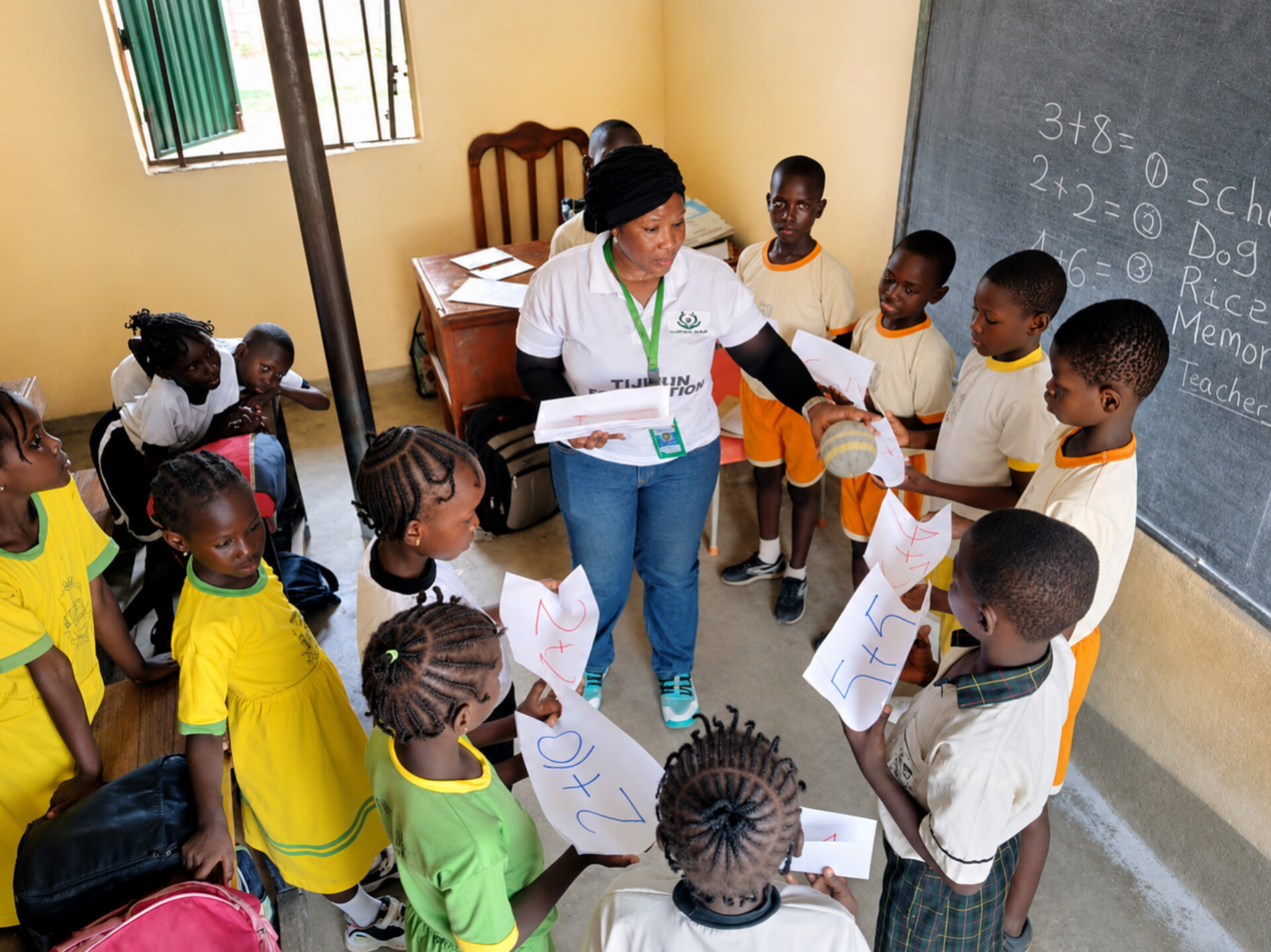
Photographs from the Yola edition document both classroom and wider school engagement. In one of the classroom sessions, pupils can be seen participating in an interactive numerical exercise while a TIJCEF team member guides the activity. Other photographs show children, school personnel and members of the Foundation together within the school premises.
The programme represents TIJCEF’s attempt to make community education support more participatory: instead of observing a school from outside, its team enters the learning environment and experiences a full school day alongside the pupils and teachers.
From School Visit to Full-Day Participation
School outreaches by civil society organisations can sometimes last only a few hours. Visitors arrive, address pupils, distribute materials, take photographs and leave.
TIJCEF’s School Takeover Day uses a different model.
For the selected day, staff and volunteers commit themselves to the school from the beginning of activities through the closing period.
This extended presence allows the Foundation to engage pupils in a setting closer to their normal learning experience.
The programme is not intended to permanently replace qualified teachers or school administrators. Instead, it provides a designated day during which TIJCEF personnel and volunteers contribute their time, knowledge and energy to supporting school activities and engaging directly with children.
Conducting the programme twice annually also distinguishes it from an isolated outreach.
Each edition becomes another opportunity for the Foundation to take its education work into a school environment and develop practical experience that can inform subsequent interventions.
Learning Takes Centre Stage
The Yola edition demonstrated the educational character of the programme.
Classroom photographs show pupils actively participating rather than sitting through a ceremonial presentation.
Children held handwritten learning materials while a TIJCEF team member facilitated an interactive exercise. The classroom board and materials visible during the activity further document that the engagement took place within an active learning setting.
That distinction is important.
TIJCEF’s involvement was not limited to gathering pupils for photographs. The team participated in activities during the school day.
Interactive engagement can also provide volunteers with a closer understanding of how children respond to different approaches to learning.
Some children may respond quickly to verbal questions. Others may participate more confidently when learning involves physical objects, group interaction or visual materials.
Spending a full day within the school gives volunteers greater exposure to these differences than would normally be possible during a brief visit.
Nigeria’s Foundational Learning Challenge Gives the Programme Wider Relevance
TIJCEF’s intervention comes against the background of a serious learning challenge facing Nigerian children.
UNICEF has warned that Nigeria faces a severe foundational learning crisis, reporting that more than 70 per cent of children lack foundational literacy and numeracy skills. The organisation has highlighted teacher capacity, learning resources and the quality of instruction among issues requiring sustained attention. UNICEF Nigeria – Enabling Teachers, Educating Children�
That national statistic should not be interpreted as an assessment of the pupils involved in TIJCEF’s Yola programme.
No learning assessment from the School Takeover Day has been presented to establish the literacy or numeracy performance of participating pupils.
Instead, the national evidence provides context for why initiatives that bring additional attention to children’s learning remain relevant.
TIJCEF’s programme cannot solve Nigeria’s foundational learning crisis, nor is a twice-yearly intervention a substitute for sustained classroom teaching.
Its contribution is much more specific: mobilising people and resources to spend a full school day supporting learning and engaging directly with a school community.
Teachers Remain Central to Education
The School Takeover Day also provides an opportunity to recognise rather than diminish the role of teachers.
Teachers perform this work every school day.
What TIJCEF staff and volunteers experience for a single day is part of the daily responsibility carried by educators throughout the academic year.
The intervention can therefore provide civil society volunteers with greater appreciation of the realities of classroom management and teaching.
UNESCO estimates that the world will need 44 million additional primary and secondary teachers by 2030 to meet universal education goals, illustrating the importance of teachers to the global education system. UNESCO – Global Report on Teachers�
The TIJCEF programme should consequently be understood as support for education, not substitution for professional educators.
Volunteers Move From Observers to Participants
The School Takeover Day also gives TIJCEF volunteers a practical role.
Volunteerism can easily become symbolic when participants are present only during opening ceremonies or photographs.
A full-day model requires more.
Volunteers have to interact with pupils.
They have to participate in activities.
They experience the rhythm of a school day.
They also have an opportunity to observe some of the practical realities affecting learning within a community-school environment.
That experience can be valuable to TIJCEF itself.
Community organisations make stronger programme decisions when they understand the environments in which beneficiaries live and learn.
A photograph or written report can communicate some information about a school.
Spending a complete day there can provide a different level of exposure.
Twice a Year Creates Opportunity for Better Measurement
Because TIJCEF conducts the School Takeover Day twice annually, the programme also presents an opportunity to strengthen the Foundation’s evidence-based approach.
Each edition can be documented using a consistent framework.
TIJCEF can record the school selected, number of pupils directly participating, number of staff and volunteers deployed, subjects or activities supported, duration of engagement and feedback from teachers and pupils.
Where appropriate, short learning assessments could also be introduced.
For example, if an edition includes a specific numeracy activity, a simple exercise administered before and after the session could provide evidence about immediate learning.
The Foundation should not manufacture improvement percentages in advance.
Results should come from actual assessments.
Over several editions, such records could transform School Takeover Day from a recurring volunteer activity into a programme with an increasingly strong evidence base.
A Programme That Can Travel Beyond One School
Another strength of the model is its potential flexibility.
Because School Takeover Day is based on mobilising staff and volunteers around a selected school, future editions can reach different communities.
This allows TIJCEF to take the programme to schools where engagement could be particularly valuable rather than concentrating every edition in one institution.
The twice-yearly structure can also create continuity without requiring TIJCEF to claim that it operates the schools involved.
The Foundation comes in for a defined intervention, works with the existing school community and completes the edition at the end of the school day.
The school remains under its normal administration.
This distinction is important when describing the term “takeover.”
TIJCEF is not assuming administrative ownership or control of a school. School Takeover Day is the programme concept used to describe a full-day intervention in which TIJCEF’s staff and volunteers immerse themselves in school activities from opening until closing.
Supporting SDG 4 at Grassroots Level
The programme also aligns with the broader objectives of Sustainable Development Goal 4, which seeks inclusive and equitable quality education and lifelong learning opportunities.
Among its targets are improvements in access to education and the acquisition of relevant learning outcomes. United Nations – Sustainable Development Goal 4�
TIJCEF’s contribution is necessarily local.
A community organisation cannot achieve a national or global education target through a single programme.
But global development objectives ultimately have to translate into activities affecting real people in real communities.
For TIJCEF, School Takeover Day provides one mechanism for making that connection.
More Than a Photograph
The images emerging from the Yola programme tell two complementary stories.
The group photograph documents the relationship between TIJCEF personnel, school representatives and pupils.
The classroom photograph goes further by showing the programme in action.
It captures children participating in an educational exercise while a member of the TIJCEF team facilitates the activity.
That second image is particularly important because it demonstrates what distinguishes School Takeover Day from an ordinary courtesy visit.
The Foundation was not simply present at the school.
Its people were participating in the school day.
From Opening Bell to Closing Time
The defining feature of TIJCEF’s School Takeover Day is ultimately its duration and level of participation.
The team arrives for the start of the school day.
Staff and volunteers engage with the school community.
They participate in learning and other activities.
And they remain through the closing period.
Then, later in the year, the programme happens again.
That twice-yearly commitment gives TIJCEF an opportunity to develop School Takeover Day into a recognisable part of its education portfolio while progressively improving how each edition is documented and evaluated.
The Yola intervention demonstrates what the concept looks like in practice: TIJCEF staff and volunteers leaving their normal routines for a day and entering the everyday learning environment of children.
It does not replace teachers.
It does not claim to solve Nigeria’s education challenges in a day.
And it should not be measured merely by photographs taken or hours spent at a school.
Its value lies in direct participation—bringing volunteers, children and educators together for a full school day centred on learning, engagement and community service.
For the pupils involved, it is a different kind of school day.
For TIJCEF staff and volunteers, it is an opportunity to serve from inside the classroom rather than from a distance.
And for the Foundation, the twice-yearly programme provides a practical expression of its commitment to taking community development directly to the places where children learn, interact and prepare for their future.
Leave a Reply