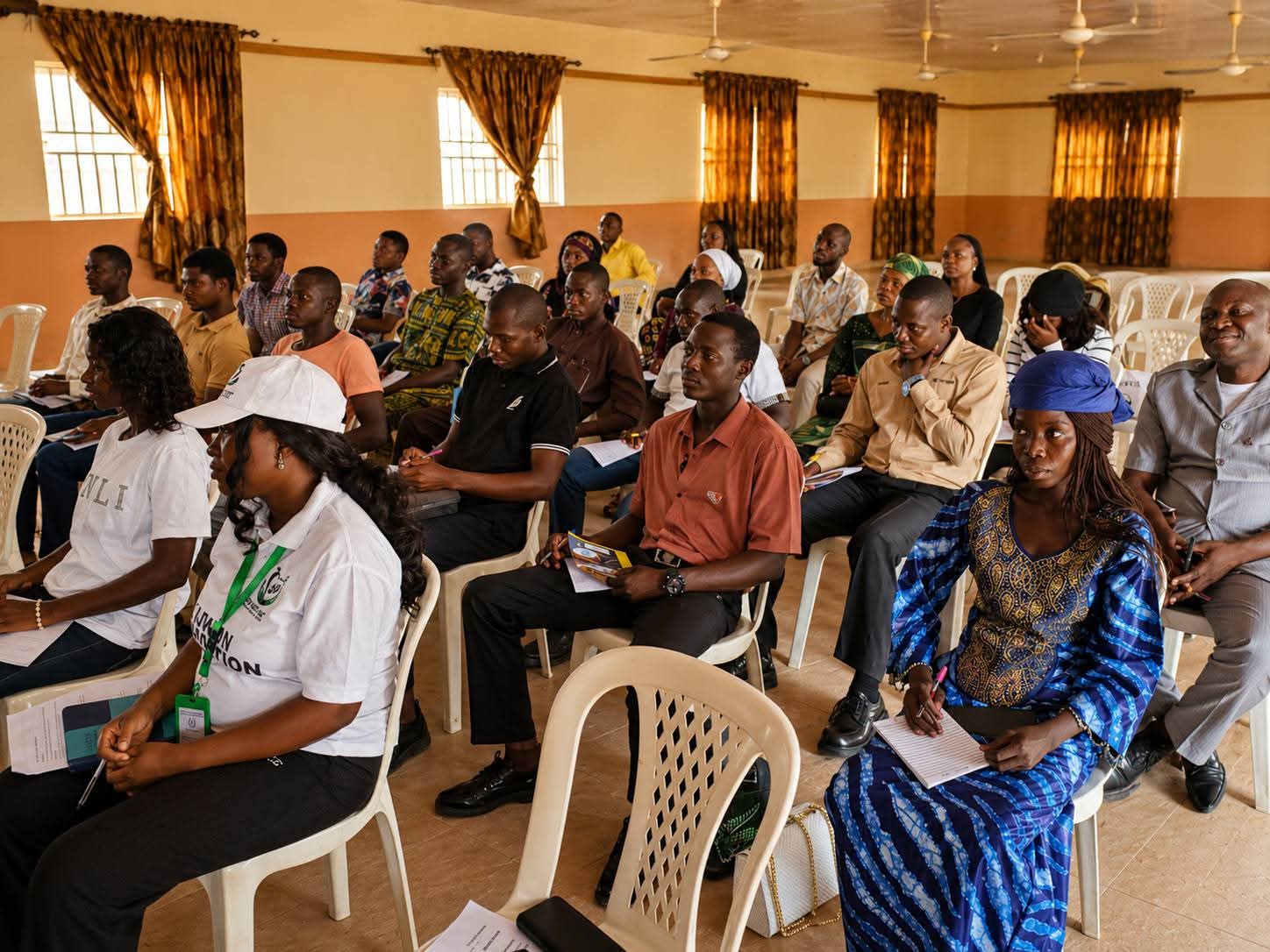
TIJCEF Builds Youth Resilience Through Empowerment Seminar in Girei
The Tijwun Care and Empowerment Foundation (TIJCEF) has strengthened its youth-development interventions in Adamawa State through an empowerment seminar held at Zion Centre in Girei, bringing together 50 young people for an engagement focused on personal development, empowerment and building capacity to navigate social and economic challenges.
The programme directly reached 50 participants, providing TIJCEF with a documented beneficiary figure for the intervention and adding to the Foundation’s growing portfolio of youth-focused activities.
Unlike TIJCEF’s girls’ empowerment programme at Adroit International Academy or its women-focused intervention in Taraba State, the Girei programme was designed specifically around young people and the importance of strengthening their capacity to respond to challenges, recognise opportunities and contribute positively to their communities.
The intervention falls under TIJCEF’s Resilience pillar, which focuses on helping individuals and communities develop the capacity to withstand challenges, adapt to changing circumstances and pursue opportunities despite social and economic pressures.
The Girei seminar was implemented against a wider national environment in which Nigerian youths continue to confront employment difficulties, skills gaps, economic pressures and uncertainty about pathways from education into sustainable livelihoods.
50 Young People Reached in Girei
According to TIJCEF’s programme records, 50 young people participated in the seminar at Zion Centre, Girei.
The figure represents direct programme participation and is not an estimate based on indirect reach.
For TIJCEF, working with a defined group of 50 participants provided an opportunity to bring young people together within a structured setting for an empowerment-focused engagement.
The programme reflected the Foundation’s belief that resilience cannot be built through material support alone.
Young people also require access to knowledge, exposure, networks and opportunities that can strengthen their ability to respond to changing circumstances.
This is particularly relevant in a country where the transition between education and employment can be difficult for many young people.
Youth Development Remains a Major Nigerian Challenge
Nigeria’s demographic structure makes youth development a national priority.
With a large and youthful population, the country’s ability to provide young people with education, skills and pathways into productive economic activity has major implications for future development.
Nigeria’s National Employment Policy 2025 recognises some of these challenges.
The International Labour Organization reported that the policy seeks to respond to unemployment and underemployment while strengthening employment creation, skills development, youth participation and inclusive economic opportunities.
The policy also places emphasis on preparing Nigerians for changes in the labour market and improving the relationship between skills development and employment opportunities. “International Labour Organization – Nigeria National Employment Policy 2025” (https://reference-url-citation.invalid/0)
TIJCEF’s Girei intervention operates at a much smaller scale than national employment programmes.
However, grassroots programmes have a different role.
They can engage young people directly within their communities and create opportunities for interaction that may be difficult to achieve through large national programmes alone.
The 50 participants reached in Girei represent this community-level approach.
Resilience Means Preparing for Challenges
TIJCEF’s classification of the programme under its Resilience pillar reflects the nature of the intervention.
Resilience is sometimes associated primarily with natural disasters or humanitarian emergencies.
For young people, however, resilience can also involve the ability to respond constructively to unemployment, economic difficulties, educational setbacks and other challenges encountered during the transition into adulthood.
This does not mean young people should simply be expected to endure difficult economic conditions.
Structural challenges require government policies, investment, employment creation and functioning public institutions.
At the individual level, however, knowledge, adaptability and access to opportunities can influence how people respond when difficulties arise.
Youth empowerment programmes can contribute to this capacity.
The Girei seminar therefore provided TIJCEF with a platform to engage 50 young people around personal development and empowerment within their local environment.
Economic Conditions Give the Programme Wider Relevance
Nigeria’s poverty situation provides additional context for grassroots resilience programmes.
The National Bureau of Statistics’ 2022 Multidimensional Poverty Index estimated that approximately 133 million Nigerians, or 63 per cent of the population, were multidimensionally poor.
The assessment went beyond income alone and examined overlapping deprivation affecting areas including education, health, living standards, work and shocks.
The survey also found a substantial geographical divide, with multidimensional poverty affecting a considerably greater proportion of people in rural areas than in urban areas. “National Bureau of Statistics – Nigeria Multidimensional Poverty Index” (https://reference-url-citation.invalid/1)
These national figures are not presented as statistics describing the 50 participants at the Girei seminar.
TIJCEF does not have evidence showing that all participants were multidimensionally poor, and such an assumption would be inappropriate.
The figures instead provide national context demonstrating the difficult economic environment in which many Nigerian young people are attempting to establish livelihoods.
Empowerment Beyond Financial Assistance
The Girei programme also reflects an important aspect of TIJCEF’s approach to empowerment.
Supporting young people does not always require direct cash or material assistance.
Information can be valuable.
Exposure can be valuable.
Skills can be valuable.
Networks can be valuable.
Encouragement combined with practical knowledge can also help young people recognise opportunities they might otherwise overlook.
This does not mean motivational programmes should be presented as substitutes for employment.
A seminar cannot create an economy.
It cannot guarantee that a participant will obtain a job or establish a successful business.
TIJCEF therefore does not report the 50 participants as having become employed or financially independent merely because they attended the programme.
The verified programme result is that 50 young people participated in the empowerment seminar.
Claims concerning subsequent employment, entrepreneurship or other livelihood outcomes would require separate evidence.
Girei Intervention Adds to TIJCEF’s Youth Work
The programme also strengthens TIJCEF’s presence in Girei and adds another location to the Foundation’s programme footprint.
TIJCEF’s activities have reached different populations in different settings, including girls in schools, women through leadership programmes and children through humanitarian outreach.
The Girei intervention focused specifically on young people.
This distinction matters because the challenges and development needs of different beneficiary groups are not identical.
A schoolgirl may require educational exposure and mentoring.
A woman participating in a leadership programme may have different priorities around livelihoods, financial inclusion or community participation.
Young adults attempting to transition into employment or entrepreneurship may require another combination of information, skills and networks.
Programme design becomes stronger when these differences are recognised.
Evidence Provides a Clear Programme Record
The Girei seminar also demonstrates the importance of maintaining verified beneficiary figures.
TIJCEF records 50 direct participants for the intervention.
The Foundation does not multiply this number by estimating how many family members or friends may subsequently have heard information from those participants.
Unless secondary beneficiaries are directly documented, they should not be included in the official programme reach.
This approach gives TIJCEF a more defensible evidence base.
It also means that when the Foundation reports its cumulative beneficiary numbers, individual programme figures can be traced back to specific activities and locations.
For the Girei programme, the evidence chain is straightforward:
TIJCEF organised the intervention.
It was held at Zion Centre in Girei.
The programme focused on youth empowerment.
And 50 young people participated.
These facts provide a stronger foundation for reporting than exaggerated claims about transformation that cannot be independently demonstrated.
Building Resilience at Community Level
Nigeria’s youth-development challenges require action at several levels.
Federal and state governments have responsibility for economic policy, education, infrastructure and employment creation.
Businesses play a role in investment and job creation.
Educational institutions develop knowledge and technical skills.
Civil society organisations can complement these systems through community-based interventions, mentoring, capacity development and connections to opportunities.
TIJCEF’s Girei seminar represents one such contribution.
Its scale was 50 participants rather than thousands.
Its geographical focus was Girei rather than the entire country.
And its intervention was an empowerment seminar rather than a national employment programme.
Reporting those boundaries clearly is important.
Grassroots impact does not have to be exaggerated to be meaningful.
Fifty Participants, One Documented Intervention
The Girei youth empowerment seminar represents a practical expression of TIJCEF’s Resilience pillar.
A total of 50 young people were directly reached through the programme at Zion Centre.
The intervention created a platform for engagement around empowerment and personal development at a time when young Nigerians continue to navigate significant economic and employment challenges.
The wider national evidence demonstrates why youth resilience matters, but TIJCEF’s contribution remains deliberately specific.
The Foundation does not claim that one seminar solved youth unemployment in Girei.
It does not claim that all 50 participants subsequently established businesses or secured jobs without evidence showing that this happened.
What TIJCEF can demonstrate is that it brought 50 young people together for an organised empowerment intervention within their community.
That documented action is the starting point for impact.
Through programmes such as the Girei seminar, TIJCEF’s Resilience pillar is being translated from an organisational value into community-level engagement helping create spaces where young people can gain exposure, strengthen their capacity and become better prepared to navigate the challenges and opportunities ahead.
Leave a Reply